
- If you are not having an IV anesthetic (not going to sleep or sedation) you may eat a light meal before your appointment and take your pills at their normally scheduled time.
- If you are having an IV anesthetic (going to sleep or sedation) you cannot have anything to eat or drink for 6 hours prior to surgery, including water. You may brush your teeth before your appointment but do not swallow any water. You may take certain medications with a sip of water as discussed in your pre-surgery consultation.
You must also have someone accompany you to the office, stay at the office, drive you home, and stay with you for 12 hours after this type of anesthesia.
- Please wear short sleeves and remove contact lenses and nose and ear piercings (if possible).
- Avoid cannabis/marijuana for 48 hours prior to surgery.
- Minors must have a legal guardian accompany them to the surgical visit to sign consents.
- If you have an illness such as a cold, sore throat, cough, or fever please contact the office.
Post-Operative (After-Surgery) Instructions For Oral Surgery
Care of the mouth after surgery has an important effect on healing. SWELLING, DISCOMFORT, AND RESTRICTED JAW FUNCTION ARE EXPECTED and shouldn’t cause alarm. These may be minimized by the following instructions:
Control of Bleeding, Oral Hygiene, and Wound Care
Remove gauze pack upon arriving home. Slight bleeding is expected. If bleeding is excessive, place a sterile gauze over the wound and bite gently but firmly for an additional 30 minutes with CONSTANT PRESSURE. Keep your head elevated while resting or sleeping. Do not rub the surgical site or disturb it with your tongue. Avoid spitting which may cause bleeding and delay healing. Do not use a drinking straw. Avoid excessive physical activity.
On the day of surgery, do not rinse your mouth with anything. The day following surgery, the mouth may be rinsed gently with a warm saltwater solution (1 teaspoon of salt in 6-8oz of warm water) after each meal and at bedtime for at least five days. If you have been given an irrigating syringe, gently use that to dislodge food particles in surgical site(s) after each meal and at bed time for at least five days. Do not brush the adjacent teeth or gums in the area of the surgery. If you were prescribed a mouth rinse, use it twice per day as directed on the bottle starting the day after surgery and continue use two weeks or until the bottle is empty. Do not rinse vigorously, as this may disturb the surgical site and delay healing.
Control of Pain and Infection
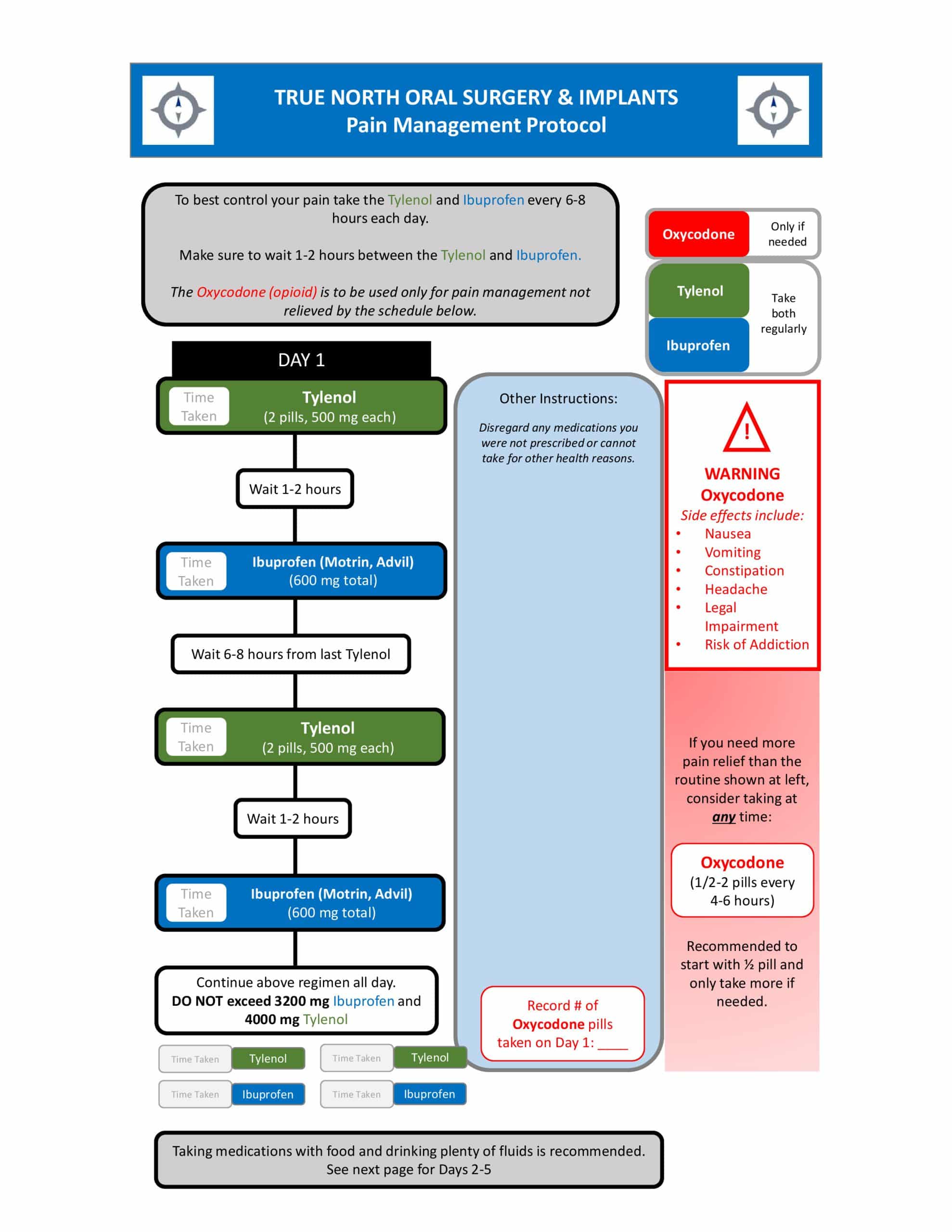
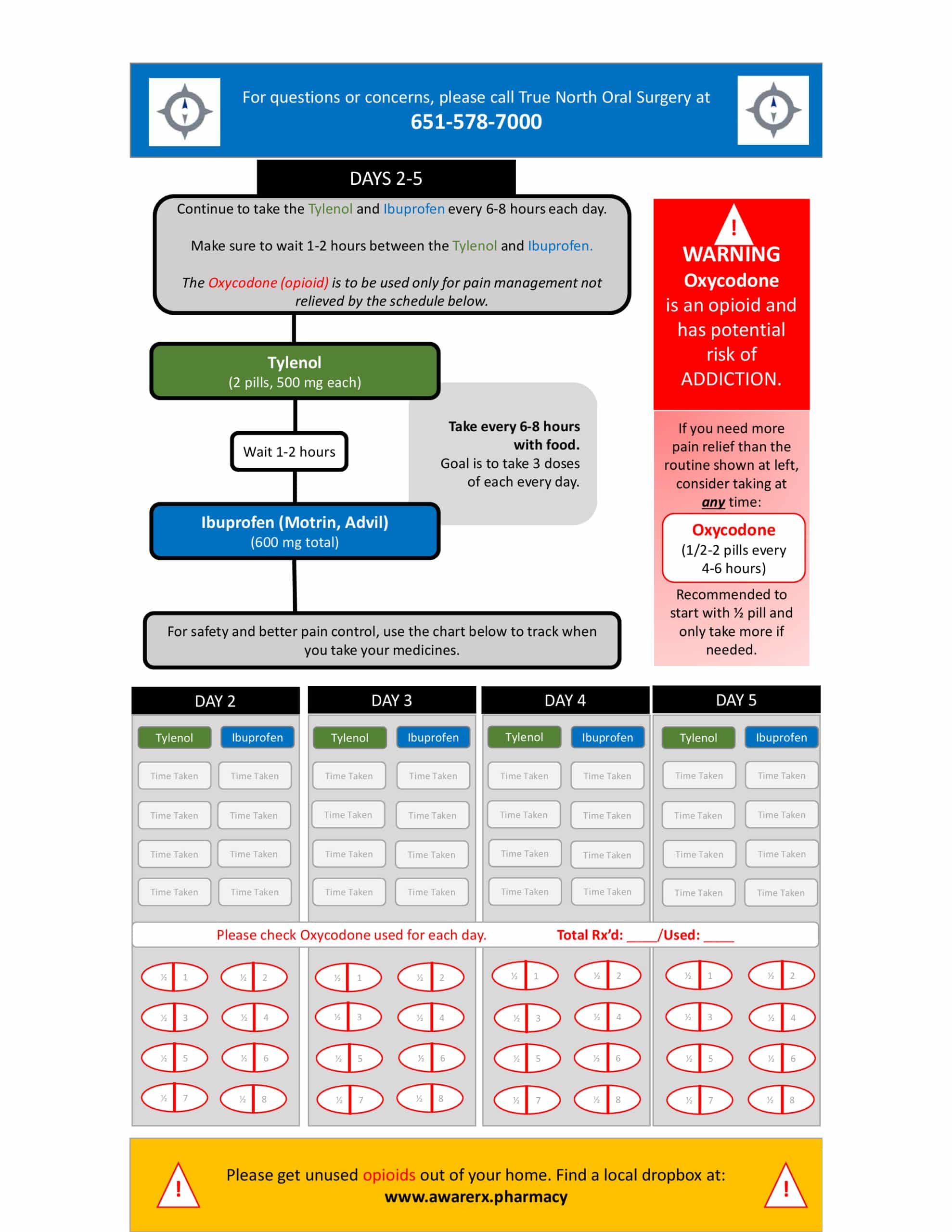
Over the counter pain medicines like acetaminophen (Tylenol) or ibuprofen (Motrin) are recommended if appropriate for you for pain control. If you have been given a prescription for medication, please take it as recommended. If you develop hives or a rash, discontinue all medication and immediately call this office. Warning: Do not drive or operate mechanical equipment after taking narcotic pain medication.
Control of Swelling
Some swelling and bruising follows nearly every surgery and will peak in 2-3 days, then slowly resolve over the next week. This swelling/bruising may be quite noticeable and may make it difficult to open your mouth. This does not necessarily mean that there is an infection present. Ice packs are of value during the first 48 hours following surgery (20 minutes on, 20 minutes off). After 48 hours, warm packs 3-4 times a day are beneficial.
Diet
A soft diet is usually recommended for the first few days following surgery. Avoid chewing on the healing site if possible. Increase your fluid intake. Avoid drinking alcohol for the first week. Avoid carbonated beverages for one week (unless nauseated as below). No straws for one week after surgery. A few soft food suggestions: noodles, mashed potatoes, scrambled eggs, yogurt, soups, ice cream, etc. You may advance your diet to more solid foods as the site(s) begins to feel less tender.
Nausea
A small amount of 7-UP, Sprite, or ginger ale will usually eliminate nausea. Follow this with mild tea or clear soup, etc. If nausea continues, please contact our office.
Smoking
Smokers are advised not to smoke or vape tobacco or cannabis after surgery. Smoking constricts blood vessels and delays bone graft healing.
Activity
Avoid strenuous physical activity for 3-5 days after surgery.
Follow Up Appointment
A follow-up appointment will not likely be necessary. If you have concerns regarding healing, please call the office. The sutures(stitches) are dissolvable and will likely fall out in two days to two weeks.
ADDITIONAL INFORMATION
The following conditions may occur, all of which are considered normal:
Numbness
Numbness of the lower lip and chin may sometimes develop on the side where a lower tooth was removed. This is usually a temporary condition which will improve with time. Please contact our office if you have numbness (cannot feel lip, tongue, or chin) which persists more than two days.
Sensitivity
Teeth near a surgery site may be temporarily sensitive.
Elevated Temperature
There may be a slight elevation of temperature for 24 to 48 hours. If the elevated temperature (greater than 100.4) continues, please contact our office.
- If you are not having an IV anesthetic (not going to sleep or sedation) you may eat a light meal before your appointment and take your pills at their normally scheduled time.
- If you are having an IV anesthetic (going to sleep or sedation) you cannot have anything to eat or drink for 6 hours prior to surgery, including water. You may brush your teeth before your appointment but do not swallow any water. You may take certain medications with a sip of water as discussed in your pre-surgery consultation.
You must also have someone accompany you to the office, stay at the office, drive you home, and stay with you for 12 hours after this type of anesthesia.
- Please wear short sleeves and remove contact lenses and nose and ear piercings (if possible).
- Avoid cannabis/marijuana for 48 hours prior to surgery.
- Minors must have a legal guardian accompany them to the surgical visit to sign consents.
- If you have an illness such as a cold, sore throat, cough, or fever please contact the office.
Post-Operative (After-Surgery) Instructions For Procedures With Bone Grafting
Care of the mouth after surgery has an important effect on healing. SWELLING, DISCOMFORT, AND RESTRICTED JAW FUNCTION ARE EXPECTED and shouldn’t cause alarm. These may be minimized by the following instructions:
Control of Bleeding, Oral Hygiene, and Wound Care
Remove gauze pack upon arriving home. Slight bleeding is expected. If bleeding is excessive, place a sterile gauze over the wound and bite gently but firmly for an additional 30 minutes with CONSTANT PRESSURE. Keep your head elevated while resting or sleeping. Do not rub the surgical site or disturb it with your tongue. Avoid spitting which may cause bleeding and delay healing. Do not use a drinking straw. Avoid excessive physical activity.
On the day of surgery, do not rinse your mouth with anything. The day following surgery, the mouth may be rinsed gently with a warm saltwater solution (1 teaspoon of salt in 6-8oz of warm water) after each meal and at bedtime. Do not brush the adjacent teeth or gums in the area of the surgery. If you were prescribed a mouth rinse, use it twice per day as directed on the bottle starting the day after surgery and continue use two weeks or until the bottle is empty. Do not rinse vigorously, as this may disturb the bone graft.
Control of Pain and Infection
Over the counter pain medicines like acetaminophen (Tylenol) or ibuprofen (Motrin) are recommended if appropriate for you for pain control. If you have been given a prescription for medication, please take it as recommended. If you develop hives or a rash, discontinue all medication and immediately call this office. Warning: Do not drive or operate mechanical equipment after taking narcotic pain medication.
Control of Swelling
Some swelling and bruising follows nearly every surgery and will peak in 2-3 days, then slowly resolve over the next week. This swelling/bruising may be quite noticeable and may make it difficult to open your mouth. This does not necessarily mean that there is an infection present. Ice packs are of value during the first 48 hours following surgery (20 minutes on, 20 minutes off). After 48 hours warm packs 3-4 times a day are beneficial.
Diet
A soft diet is usually recommended for the first few days following bone graft surgery. Take great care to not chew on the bone graft site until the gums have healed across the site, usually three to six weeks. Increase your fluid intake. Avoid drinking alcohol for the first week. Avoid carbonated beverages for one week (unless nauseated as below). No straws for one week after surgery. A few soft food suggestions: noodles, mashed potatoes, scrambled eggs, yogurt, soups, ice cream, etc.
Nausea
A small amount of 7-UP, Sprite, or ginger ale will usually eliminate nausea. Follow this with mild tea or clear soup, etc. If nausea continues, please contact our office.
Smoking
Smokers are advised not to smoke or vape tobacco or cannabis after surgery. Smoking constricts blood vessels and delays bone graft healing.
Activity
Avoid strenuous physical activity for 3-5 days after bone grafting surgery.
Follow Up Appointment
A follow-up appointment will not likely be necessary. If you have concerns regarding healing, please call the office. The sutures(stitches) are dissolvable and will likely fall out in two days to two weeks.
ADDITIONAL INFORMATION
The following conditions may occur, all of which are considered normal:
Numbness
Numbness of the lower lip and chin may sometimes develop on the side where a lower tooth was removed. This is usually a temporary condition which will improve with time. Please contact our office if you have numbness (cannot feel lip, tongue, or chin) which persists more than two days.
Sensitivity
Teeth near a surgery site may be temporarily sensitive.
Elevated Temperature
There may be a slight elevation of temperature for 24 to 48 hours. If the elevated temperature (greater than 100.4) continues, please contact our office.
If you are not having an IV anesthetic (going to sleep or IV sedation) you may eat a light meal before your appointment and take your pills at their normally scheduled time. If you are having an IV anesthetic (going to sleep or IV sedation) you cannot have anything to eat or drink for 6 hours prior to surgery, including water. You may brush your teeth before your appointment but do not swallow any water. You may take certain medications with a sip of water as discussed in your presurgery consult. You must have someone drive you home after this type of anesthesia and stay with you for 12 hours.
Biopsy Post-Operative Instructions
Please read these instructions carefully. Sometimes the after-effects of oral surgery are quite minimal, so not all of theseinstructions may apply. Common sense will often dictate what you should do. However, when in doubt, follow these guidelines or call our office for clarification.
Day of Surgery
Do not disturb the surgical area today. DO NOT SMOKE for at least 3 days, as smoking is very detrimental to healing. Bleeding or Oozing Some minor bleeding will be evident in the first 48 hours. Usually direct pressure with a gauze pack for 20 to 30 minutes will easily control this. If bleeding persists or intensifies, please call the office. Bruising may occur on the outside of the face near the area of the biopsy site. This occurrence is not unusual and will resolve within ten to fourteen days.
Swelling
Often there is some swelling near the biopsy site. This is normal and should resolve within three to four days. When possible, apply ice packs to the area intermittently for the first 24 hours to help reduce swelling.
Pain
Unfortunately most oral surgery is accompanied by some degree of discomfort. In most cases, pain medication will be prescribed by your surgeon. Acetaminophen or Ibuprofen can also be used to control any pain.
Diet
Eat any nourishing food that can be taken with comfort. It is sometimes advisable, but not required, to confine the first day’s intake to liquids or pureed foods (creamed soups, puddings, yogurt, milk shakes, etc.). Over the next several days you can progress to solid foods at your own pace. It is important not to skip meals. If you take nourishment regularly, you will feel better, gain strength, have less discomfort, and heal faster.
Oral Hygiene
Keeping your mouth clean after surgery is essential. Use one teaspoon of salt dissolved in an 8-ounce glass of warm water and gently rinse with portions of the solution, taking five minutes to use the entire glassful. Repeat as often as you like, but at least four to five times daily for the next five days. You may brush your teeth, but avoid the biopsy site. It is our desire that your recovery be as smooth and pleasant as possible. Following these instructions will help your healing, but if you have questions about your progress, please call our office at 651.578.7000
Test Results
Your surgeon will send your biopsy specimen to an oral pathologist for processing, interpretation, and reporting. You will be contacted with the results of the biopsy when the test results are received. The results usually arrive within seven to ten working days.
Do
- Use your fingers to put your aligners in place. First place the aligners over your front teeth, and then use your fingers to push the aligner down gently over your molars. When aligners are correctly inserted, they will fit all the way down on the teeth, with no space between the top of the aligners and the top of the teeth. Aligners will fit tightly at first but should fit well at the end of the two week period.
- Keep aligners in except when flossing, brushing, eating. It’s also best to remove the aligners when drinking warm beverages such as coffee or tea.
- Remove the aligner by pulling it off both sides of your back teeth simultaneously then lifting it off of your front teeth. Place your aligners in the case we provided any time they are not being worn.
- Clean aligners with a toothbrush and toothpaste.
- Wear each set of aligners for two weeks unless our office directs you to vary from this schedule.
- Wear aligners in the correct numerical order. (Each aligner is labeled by number and with a U or an L to designate upper or lower.)
- Keep all of your old aligners and bring them to your orthodontic appointments.
Don't
- Don’t place your aligners in or on a napkin or tissue. Many aligners have accidentally been thrown out this way!
- Don’t use your teeth to “bite” your aligners into place.
- If you have pets, don’t place your aligners anywhere that your pets can reach them. Pets are attracted to saliva and would enjoy chewing on your Invisalign trays!
- Do not use Denture cleaner, alcohol, or bleach to clean your aligners.
- Do not use boiling water or warm water on your aligners.
- Don’t chew gum with your aligners in.
- It would be best not to smoke while wearing aligners. The smoke can stain the aligners as well as your teeth.
Just in Case
- If you lose the tab attached to your tooth that helps the aligner snap on, please call our office right away so that we can determine if you need to come in before your next scheduled appointment.
- If you lose one of your aligner trays, please wear the next tray if you have it. If you do not have the next tray, please wear the previous tray. It is extremely important to use a tray to keep teeth from shifting. Call our office to let us know which tray was lost so that we can determine if a replacement tray is needed. There will be a fee if replacement trays are required.